Product
Product Facts
- Product Name
- DSC Krunch 300 Batting Pads
- Availability
- In Stock
- Fulfillment Type
- online
- Brand
- DSC
- Category
- Sports & Outdoors > Cricket Equipment
90.00 AUD
The Krunch 300 is a junior batting pad from DSC's Krunch range, in the Boys size for a left-handed batter.Specifications
Range: DSC Krunch
Hand: Left hand
Size: Boys
Construction and strap details for this pad are not published by DSC. Call our Adelaide team on (08) 7095 5777 and we will check the pad in store for you.
| Variant | Price | Availability |
|---|---|---|
| 8880002422526 | 90.00 AUD |
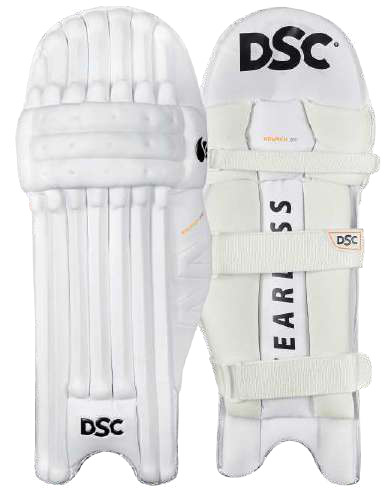
DSC Krunch 300 Batting Pads
DSC Krunch 300 Batting Pads at a glance
| Brand | DSC |
| Category | Batting pads |
| Price | $90.00 |
| Availability | In stock (1 of 1 variant) |
| Size | BOYS |
| Type | LH |
| SKU | 8880002422526 |
| Tags | batting-pads, dsc, junior |
| Sold by | Cricket For All, Gilles Plains, South Australia |
Product description
DSC Krunch 300 batting pads combine lightweight foam and cane with a compact shin profile. Breathable mesh-lined bolsters support comfort, while an extended side wing adds coverage.
Key features
- High-density foam and cane construction
- Extended foam side wing
- Three-section shin bolster
- Breathable mesh-lined bolsters
- PU facing and reinforcement
- Wide butterfly-style straps
- Select the required size and batting hand
Variants and availability
| Variant | Price | Was | SKU | In stock |
|---|---|---|---|---|
| BOYS / LH | $90.00 | — | 8880002422526 | Yes |
How to choose batting pads
Pads are sized by leg length, and correct sizing is a safety matter, not a comfort preference.
Sizing
Measure from the centre of the knee to the top of the instep with the player standing.
| Size | Knee-to-instep |
|---|---|
| Small Boys | up to 30 cm |
| Boys | 30-34 cm |
| Youth | 34-37 cm |
| Small Adult | 37-40 cm |
| Adult (Men's) | 40-44 cm |
| Adult XL / Long | 44 cm+ |
The knee roll must sit on the knee. A pad that is too long pushes the knee roll above the joint and leaves the top of the shin exposed - the exact area a ball skidding through low will find. Too short and the instep is unprotected.
Construction
- Traditional cane - vertical cane rods with bolsters, the classic construction. Excellent impact dispersion, heavier, favoured at senior level.
- High-density foam - lighter, cheaper, quicker to dry, less effective against genuine pace.
- Hybrid - cane in the shin, foam in the wings and knee roll. The common mid-range compromise.
Weight and running
Pad weight is felt most between the wickets, late in an innings. Lightweight pads help with running but disperse impact less. Junior players almost always want the lighter option; senior players facing pace should not compromise shin protection for a few hundred grams.
Getting pad sizing right
Pad sizing is the area where "close enough" causes actual injury, because the consequence of a mis-sized pad is not discomfort but an exposed shin.
The measurement
Stand upright. Measure from the centre of the kneecap to the top of the instep - not to the floor, not to the ankle bone. That figure determines the size.
| Size | Knee-to-instep |
|---|---|
| Small Boys | up to 30 cm |
| Boys | 30-34 cm |
| Youth | 34-37 cm |
| Small Adult | 37-40 cm |
| Adult (Men's) | 40-44 cm |
| Adult XL / Long | 44 cm+ |
Manufacturers vary slightly, so treat these as a guide and check the specific brand's chart where available.
Why too long is worse than too short
If a pad is too long, the knee roll rides above the kneecap. That does two things: it leaves the top of the shin - directly below the knee - covered only by thin material or nothing, and it stops the pad flexing at the joint, so the player runs stiffly and the pad rotates.
The top of the shin is exactly where a ball skidding through low arrives. A pad that is slightly short still protects the shin; a pad that is too long does not.
Construction in detail
Traditional cane. Vertical cane rods running the length of the shin, separated by foam bolsters. Cane distributes impact along its length and across adjacent rods, which is why it remains the choice at senior level against genuine pace. Heavier, and more expensive to make.
High-density foam. Moulded closed-cell foam, sometimes with reinforcing inserts. Lighter, cheaper, faster to dry, and it disperses less energy. Entirely appropriate for junior and social cricket.
Hybrid. Cane through the shin where impact energy is highest, foam in the wings and knee roll where it is not. The common mid-range compromise and a sensible one.
Weight, running, and the trade-off
Pad weight is felt between the wickets, and most acutely late in a long innings when fatigue is already a factor. Lighter pads genuinely help running.
The trade-off is real: lighter almost always means less impact dispersion. The sensible resolution depends on what the player faces. A junior playing on slow surfaces against gentle bowling should take the lighter pad. A senior player facing 130 km/h should not save 300 grams at the cost of shin protection.
Fitting
- Wings face outward. The wider side flap protects the outside of the leg. Pads worn the wrong way round leave the inside exposed and catch each other when running.
- Straps buckle behind the leg, not on the inside where they snag.
- Three straps is standard; the middle strap carries most of the load.
- Tension: firm enough that a hard shake does not rotate the pad, loose enough not to restrict the calf. Over-tight straps cause cramping.
Check the fit standing and then in a batting stance - a pad that fits standing can bind at the knee when the front leg bends.
Care
Hang pads to dry after every use. The facing absorbs sweat and rain, and stored damp the internal foam degrades and straps rot. Wipe the facing with a damp cloth; never machine wash, which delaminates the facing from the padding.
Replace pads when the foam has hardened and lost rebound, when the facing has split enough to admit water, or when straps no longer hold tension.
Batting pad terms
- Knee roll - the horizontal padded roll that sits over the kneecap; it must align with the joint.
- Bolster - the padded roll running down the pad face, dispersing impact.
- Wing - the side flap protecting the outside of the leg; wings face outward.
- Instep - the lower section covering the top of the foot.
- Facing - the outer covering material, usually PVC or synthetic leather.
- Cane - vertical rods traditionally used inside the shin for impact dispersion.
- High-density foam - the lighter modern alternative to cane.
Common questions about batting pads
How do I measure for batting pads?
Stand upright and measure from the centre of the kneecap to the top of the instep. That measurement, not age or height, determines pad size. If between sizes, size down: a pad slightly short still protects the shin, whereas a pad too long pushes the knee roll above the joint.
Which way round do batting pads go?
The wing - the wider flap on one side - protects the outside of the leg, so wings face outward. Straps buckle behind the leg. Pads worn the wrong way leave the inside of the leg exposed and catch on each other when running.
How tight should pad straps be?
Firm enough that the pad does not rotate when you shake your leg, loose enough not to restrict the calf. The middle strap carries most of the load. Over-tight straps restrict blood flow and cause cramping late in an innings.
Are lightweight pads less safe?
Generally yes, at the margins. Lightweight pads use high-density foam rather than cane and disperse less impact energy. For junior and social cricket the trade-off favours lightness; for senior players facing genuine pace, shin protection should win.
Can batting pads be used for wicketkeeping?
They can, but they should not be. Batting pads are longer, heavier and bulkier at the knee roll, which restricts the keeper's squat and slows the rise. Keeping pads are a different shape for a reason.
How do I stop pads smelling?
Air them after every use rather than sealing them in the kit bag. The facing absorbs sweat and rain; stored damp, the foam degrades and the straps rot. Wipe the facing with a damp cloth, never machine wash.
Where this sits in the range
Cricket For All stocks 138 other batting pads items, priced from $39.99 to $299.99. At $90.00 this one sits around the middle of that range.
Closest alternatives in the same category, matched on shared product tags:
| Product | Brand | Price |
|---|---|---|
| DSC Flip 300 Batting Pads - Junior | DSC | $55.00 |
| DSC Spliit 44 Batting Pads - Junior | DSC | $82.00 |
| DSC Pearla 5000 Batting Pads - Junior | DSC | $69.00 |
| DSC Flip 500 Batting Pads - Junior | DSC | $50.00 |
| DSC Flexlite Coloured Batting Pads - Senior | DSC | $190.00 |
| NEW BALANCE DC 300 TWIN BATTING PADS - AMBI | New Balance | $65.00 |
What to buy alongside
Thigh guards and an abdominal guard complete the lower-body set that pads begin.
About DSC
DSC is an Indian manufacturer producing a broad range of bats, protective equipment and bags across entry-level and mid-range price points, widely used in club and junior cricket.
Ranges this product appears in
- DSC Batting Pads — 6 products
- DSC — 30 products
- Batting Pads — 45 products
- Shop All Batting Pads — 94 products
- Junior Cricket — 335 products
- All Cricket Gear Except Balls — 1451 products
Buying from Cricket For All
Cricket For All is an Adelaide cricket centre and online store at Unit 1-2, 621-623 North East Road, Gilles Plains, South Australia. Free standard shipping applies to eligible Australian merchandise orders of A$100 or more before cart rewards. Standard shipping is A$15 otherwise; express is A$20. Exclusions and weight limits apply. See the current shipping policy at https://www.cricketforall.com.au/policies/shipping-policy for full terms.
The store sits inside a working cricket centre with indoor lanes and bowling machines, so equipment advice comes from nationally accredited coaches who see the same gear in use daily rather than from a catalogue. Trading hours are Monday to Thursday 12:00pm-10:00pm, Friday 12:00pm-9:00pm, and Saturday and Sunday 10:00am-6:00pm. Phone (08) 7095 5777 or email retail@cricketforall.com.au.
Price, variant and availability details reflect the catalogue when this page was compiled; the live product page carries current pricing and stock.
What product is featured on this page?
The DSC Krunch 300 Batting Pads, a junior cricket batting protection product designed for young players.
Who is the manufacturer of the Krunch 300 Batting Pads?
DSC is the manufacturer of the Krunch 300 Batting Pads.
What price is listed for the DSC Krunch 300 Batting Pads?
The DSC Krunch 300 Batting Pads are priced at AUD 90.00.
What variant of the DSC Krunch 300 Batting Pads is available on this page?
The available variant is the Boys / Left-Handed (LH) version.
What is the SKU/GTIN for the DSC Krunch 300 Batting Pads (Boys/LH)?
The SKU and GTIN for this variant is 8880002422526.
Is the Boys/LH variant of the DSC Krunch 300 Batting Pads in stock?
Yes, according to the page's product data, the Boys/LH variant is listed as in stock.
Who should use the left-handed configuration of these batting pads?
The left-handed configuration is suitable for left-handed young (junior) batsmen who require leg protection during cricket play.
Where can customers buy the DSC Krunch 300 Batting Pads?
They are available through Cricket For All, which describes itself as Adelaide's premier cricket destination, via their online store at cricketforall.com.au or at their physical location at Gilles Plains.
What category of cricket equipment does this product belong to?
It belongs to the Batting Pads category, part of DSC's Krunch 300 series of protective equipment for junior cricketers.
Images on This Page
-
https://www.cricketforall.com.au/cdn/shop/files/CricketForAll_CMYK.svg?v=1783640586&width=327
Cricket For All
-
https://www.cricketforall.com.au/cdn/shop/files/CricketForAll_WHITE.svg?v=1783640556&width=327
(no alt text)
-
https://www.cricketforall.com.au/cdn/shop/files/tours-thumb.jpg?v=1783996337&width=650
(no alt text)
-
https://www.cricketforall.com.au/cdn/shop/files/lanes-thumb.jpg?v=1783996357&width=650
(no alt text)
-
https://www.cricketforall.com.au/cdn/shop/files/dsc-au-2022-x865.png?v=1788654257&width=386
DSC Krunch 300 Batting Pads — manufacturer design photograph
-
https://www.cricketforall.com.au/cdn/shop/files/split-44-batting-gloves.webp?v=1788607428&width=160
DSC Spliit 44 Batting Gloves - Junior
-
https://www.cricketforall.com.au/cdn/shop/files/dsc-eco-10-kit-bag-4.jpg?v=1788611330&width=160
DSC Eco 10 Duffle Bag


