Product
Product Facts
- Product Name
- Kookaburra Balls Practice (156g)
- Availability
- In Stock
- Fulfillment Type
- online
- Brand
- Kookaburra
Kookaburra Balls Practice (156g) is a Kookaburra cricket ball stocked at Cricket For All in Adelaide. Available in Color: Red, White.Specifications
Weight: 156 g
Colour: Red, White
Brand: Kookaburra
Kookaburra has not published a detailed specification for this model, so we list only what is on the product record. Call our Adelaide team on (08) 7095 5777 and we will check the item in store for you.
| Variant | Price | Availability |
|---|---|---|
| 2500000202526 | 36.00 AUD | |
| CFA-49264285909243 | 33.00 AUD |
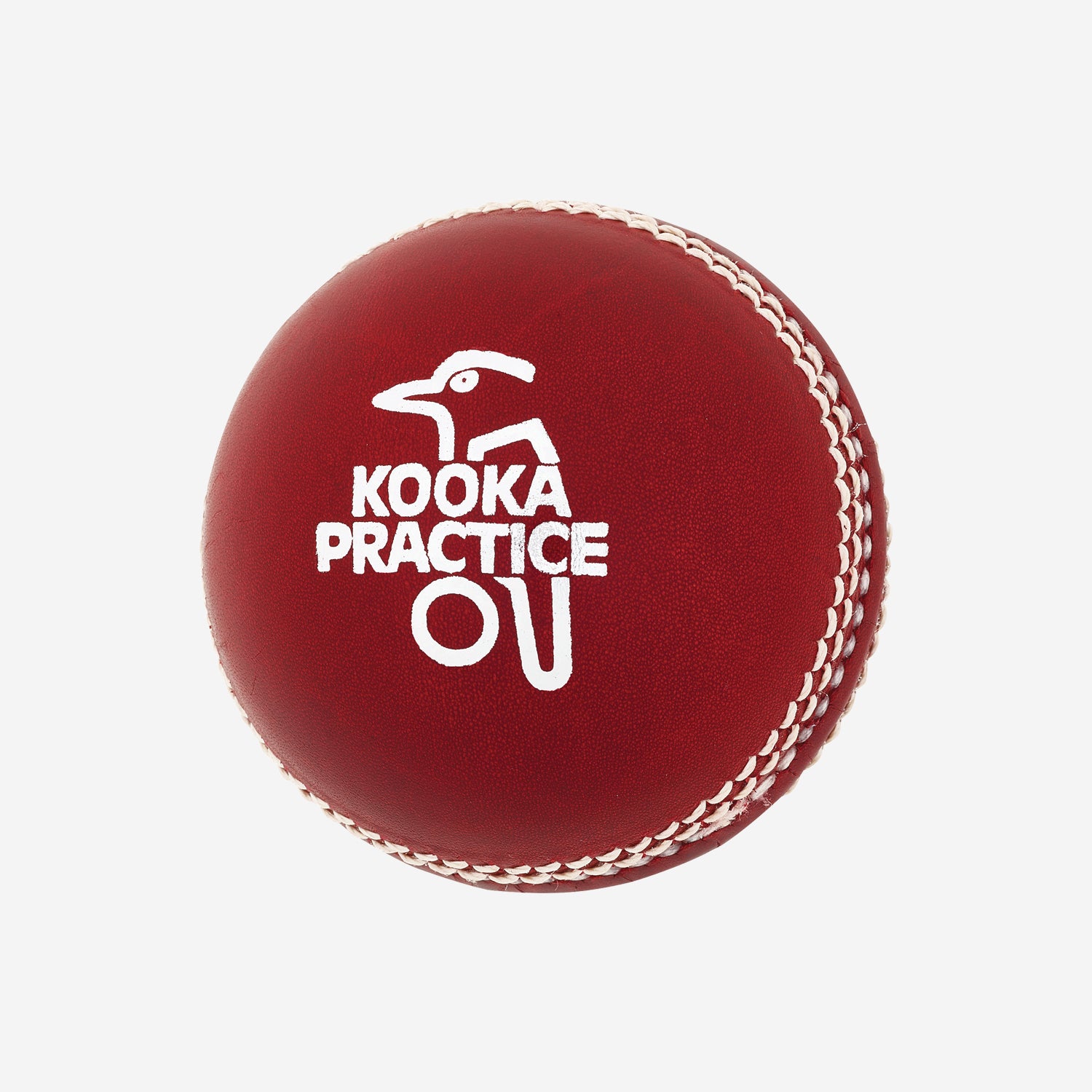
Kookaburra Balls Practice (156g)
Kookaburra Balls Practice (156g) at a glance
| Brand | Kookaburra |
| Category | Cricket balls |
| Price | $33.00 – $36.00 AUD |
| Availability | In stock (2 of 2 variants) |
| Color | White, Red |
| SKU | 2500000202526 |
| Sold by | Cricket For All, Gilles Plains, South Australia |
Product description
The Australian-made Kookaburra Practice ball is designed for training and recreational cricket. Its two-piece leather construction surrounds a moulded cork-and-rubber core for repeated practice use.
Key features
- Made in Australia
- Two-piece construction
- Selected leather cover
- Moulded granulated cork and rubber core
- 156 g model
- Select the required colour
Variants and availability
| Variant | Price | Was | SKU | In stock |
|---|---|---|---|---|
| White | $36.00 | — | 2500000202526 | Yes |
| Red | $33.00 | — | — | Yes |
How to choose a cricket ball
Ball choice is governed by grade of cricket, surface and match length, and using the wrong one wastes both money and practice quality.
Weight and who uses it
| Weight | Used by |
|---|---|
| 142 g (5 oz) | Women's cricket, and some junior grades |
| 156 g (5.5 oz) | Men's senior cricket, standard for club and above |
| 133-142 g | Junior grades, varying by association |
Junior weights vary by association - check the local playing conditions before buying.
Construction
- Four-piece - four quarters of leather, a full seam, and a cork-and-wound-string core. Holds shape, retains seam, and swings and seams longer. Used for senior and representative cricket.
- Two-piece - two hemispheres. Cheaper, adequate for junior and social cricket, loses shape faster.
- Machine-stitched vs hand-stitched - hand-stitched seams stand more proud and last longer. Machine-stitched is fine for training.
Colour
Red for multi-day and traditional formats, white for limited-overs and coloured clothing, pink for day-night cricket. White balls scuff and discolour faster; pink balls have a reinforced lacquer and behave differently under lights.
Training balls
Practice balls, incrediballs, wind balls and bowling-machine balls are not match balls and should not be treated as such. Bowling machines require specific machine balls - firing a leather match ball through a machine damages both the ball and the machine's wheels. Cricket For All's Bola machines at Gilles Plains use dedicated machine balls.
Care
A match ball is a consumable. Keep it dry, don't pick the seam, and retire it to practice once the lacquer has gone and the seam has flattened.
How a cricket ball behaves and why it matters
A cricket ball is not an inert object: its condition determines what a bowler can do with it, and understanding that shapes which ball you buy for which purpose.
Swing
Swing comes from asymmetry between the two sides of the ball. Conventional swing needs one shiny side and one rougher side, with the seam angled toward the intended direction. This is why fielding sides polish one side obsessively. Reverse swing appears when the ball is old and the rough side is heavily scuffed.
A ball's ability to swing depends on the quality of its lacquer and the prominence of its seam - both of which are functions of construction quality. A hand-stitched four-piece ball holds a proud seam far longer than a machine-stitched two-piece, which is why serious cricket uses the former.
Seam movement
Seam movement comes from the ball landing on the seam and deviating. A proud, well-stitched seam grips the surface; a flattened seam does not. This is the main reason a ball that has "gone soft" stops doing anything off the pitch.
Hardness and scoring
A new ball is hard and comes off the bat fast, which is why the new ball is both dangerous to face and profitable to bat against once seen off. As the ball softens it becomes harder to score with, which is a large part of why middle overs in limited-overs cricket are slower.
Choosing by purpose
| Purpose | Ball |
|---|---|
| Senior match cricket | 156 g four-piece leather, red or white by format |
| Junior match cricket | 133-142 g, weight per association rules |
| Women's cricket | 142 g |
| Net practice | Two-piece leather or used match balls |
| Bowling machine | Dedicated machine balls only |
| Junior introduction / indoor | Incrediball, wind ball or soft-centre training ball |
Storage and care
Keep match balls dry and out of direct heat. A ball stored wet loses shape and the leather hardens unevenly. Do not pick at the seam - beyond being against the laws in match play, it destroys the ball's most useful feature. Once the lacquer is gone and the seam flattened, retire the ball to practice; a dead ball teaches bowlers nothing useful.
Colour and format
Red balls are used for multi-day and traditional formats and hold their condition longest. White balls are used for limited-overs cricket with coloured clothing; they scuff and discolour faster, which is why one-day cricket often uses two. Pink balls were developed for day-night first-class cricket, with extra lacquer for visibility under lights, and behave differently again - they tend to retain hardness longer and swing more in the evening session.
Cricket ball terms
- Seam - the stitched ridge around the ball's circumference.
- Quarter - one of the four leather panels of a four-piece ball.
- Lacquer - the surface coating that helps a new ball retain shine and swing.
- Four-piece / two-piece - construction from four leather quarters or two hemispheres.
- Reverse swing - late swing toward the shiny side, occurring with an old, heavily scuffed ball.
- Machine ball - a ball built specifically for bowling machines.
Common questions about cricket ball
What weight ball should a junior use?
Junior weights vary by association and age group, commonly 133 g to 142 g before moving to the senior 156 g. Check your local playing conditions - buying the wrong weight makes a ball unusable for matches.
What is the difference between a two-piece and four-piece ball?
A four-piece ball is made from four leather quarters with a full seam and a wound core; it holds shape, keeps its seam and swings longer. A two-piece is made from two hemispheres, is cheaper, and loses shape faster. Four-piece for senior and representative cricket, two-piece for junior and social.
Can I use a match ball in a bowling machine?
No. Bowling machines require dedicated machine balls. Firing a leather match ball through a machine damages the machine's wheels and destroys the ball. Cricket For All's Bola machines use purpose-made machine balls.
Why do white balls behave differently from red?
White balls are lacquered differently and scuff and discolour faster, which affects how long they swing. Pink balls carry a reinforced lacquer for day-night play and behave differently again under lights.
How should a match ball be cared for?
Keep it dry, do not pick the seam, and retire it to practice once the lacquer is gone and the seam has flattened. A match ball is a consumable, not equipment.
Where this sits in the range
Cricket For All stocks 63 other cricket balls items, priced from $6.00 to $240.00. At $36.00 this one sits around the middle of that range.
Closest alternatives in the same category, matched on shared product tags:
| Product | Brand | Price |
|---|---|---|
| Kookaburra Balls Practice (142g) | Cricket For All | $33.00 |
| CFA Practice 4pc Red Ball - 156g (Last Year NEJCA) | Cricket For All | $25.00 |
| Kookaburra Balls Crown (156g) | Cricket For All | $33.00 |
| Kookaburra Balls Zenith (156g) | Cricket For All | $21.00 |
| Kookaburra Balls Commander (156g) | Cricket For All | $18.00 |
| Kookaburra Balls Tuf Pitch (156g) | Cricket For All | $64.00 |
What to buy alongside
Dry, shaped storage keeps a match ball's seam and lacquer between games.
About Kookaburra
Kookaburra is an Australian manufacturer established in Melbourne in 1890, best known globally for the Kookaburra cricket ball used in most Test-playing nations outside England and India. Its bat and protective ranges are extensive and cover every price point.
Ranges this product appears in
- Kookaburra — 502 products
- All Cricket Gear Except Balls — 1451 products
Buying from Cricket For All
Cricket For All is an Adelaide cricket centre and online store at Unit 1-2, 621-623 North East Road, Gilles Plains, South Australia. Free standard shipping applies to eligible Australian merchandise orders of A$100 or more before cart rewards. Standard shipping is A$15 otherwise; express is A$20. Exclusions and weight limits apply. See the current shipping policy at https://www.cricketforall.com.au/policies/shipping-policy for full terms.
The store sits inside a working cricket centre with indoor lanes and bowling machines, so equipment advice comes from nationally accredited coaches who see the same gear in use daily rather than from a catalogue. Trading hours are Monday to Thursday 12:00pm-10:00pm, Friday 12:00pm-9:00pm, and Saturday and Sunday 10:00am-6:00pm. Phone (08) 7095 5777 or email retail@cricketforall.com.au.
Price, variant and availability details reflect the catalogue when this page was compiled; the live product page carries current pricing and stock.
What is the Kookaburra Balls Practice (156g)?
The Kookaburra Balls Practice (156g) is a cricket ball product made by Kookaburra, designed for practice sessions and training purposes, weighing 156 grams.
How much does the Kookaburra Balls Practice (156g) cost?
The Kookaburra Balls Practice (156g) is priced at AUD 36.00.
What color option is available for the Kookaburra Balls Practice (156g)?
The Kookaburra Balls Practice (156g) is available in White.
Is the Kookaburra Balls Practice (156g) currently in stock?
Yes, the Kookaburra Balls Practice (156g) is listed as In Stock.
What is the SKU for the Kookaburra Balls Practice (156g)?
The SKU for the Kookaburra Balls Practice (156g) is 2500000202526.
What brand makes the Kookaburra Balls Practice (156g)?
The Kookaburra Balls Practice (156g) is made by Kookaburra, a major Australian cricket equipment manufacturer renowned for producing high-quality, durable cricket gear used across Australia and internationally.
Where can I buy the Kookaburra Balls Practice (156g)?
The Kookaburra Balls Practice (156g) can be purchased through Cricket For All's online platform at cricketforall.com.au, a leading cricket equipment retailer headquartered in Adelaide, South Australia.
What currency is the price of the Kookaburra Balls Practice (156g) listed in?
The price of the Kookaburra Balls Practice (156g) is listed in AUD (Australian Dollars), priced at 36.00 AUD.
Images on This Page
-
https://www.cricketforall.com.au/cdn/shop/files/CricketForAll_CMYK.svg?v=1783640586&width=327
Cricket For All
-
https://www.cricketforall.com.au/cdn/shop/files/CricketForAll_WHITE.svg?v=1783640556&width=327
(no alt text)
-
https://www.cricketforall.com.au/cdn/shop/files/tours-thumb.jpg?v=1783996337&width=650
(no alt text)
-
https://www.cricketforall.com.au/cdn/shop/files/lanes-thumb.jpg?v=1783996357&width=650
(no alt text)
-
https://www.cricketforall.com.au/cdn/shop/files/1A1164.jpg?v=1788607220&width=1500
Kookaburra Balls Practice (156g)
-
https://www.cricketforall.com.au/cdn/shop/files/3S18775-BallBagBlackLime-1.jpg?v=1784447455&width=160
Kookaburra Ball Bag
-
https://www.cricketforall.com.au/cdn/shop/files/1A1150_8d807846-3697-412b-b5a5-496a93a2a2dd.jpg?v=1788616078&width=1500
Kookaburra Zenith red cricket ball
-
https://www.cricketforall.com.au/cdn/shop/files/1A1167_fdda5471-9af4-43eb-8df3-b63048f59508.jpg?v=1788608183&width=1500
Kookaburra Balls Crown (156g)


